
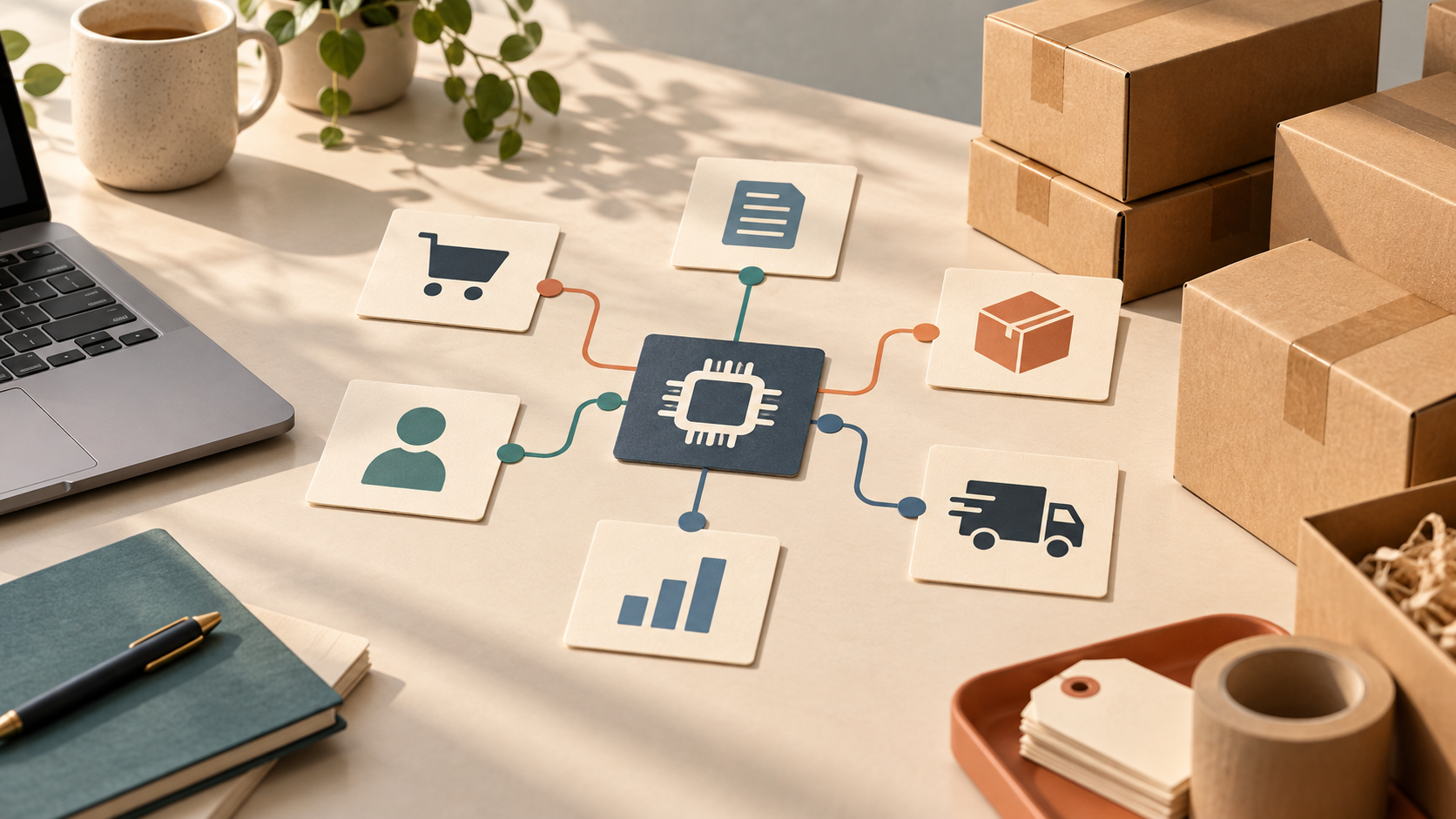
AI is reshaping e-commerce operations — from order handling and returns to full workflow automation. This guide explores how AI-powered systems streamline fulfillment, enhance the customer experience, and drive scalable growth. It also provides practical insights on automated fulfillment, intelligent order tracking, and returns automation, along with strategies to integrate AI into existing workflows for businesses of any size.
How does AI transform order management automation?
AI improves order management through real-time data analysis and automated decision-making. It enables smarter inventory control, demand forecasting, and personalized communications. Machine learning models identify operational patterns to reduce errors, accelerate fulfillment, and help teams respond quickly to sudden changes. The result is a more adaptive order system that meets customer expectations while minimizing operational friction. See how the Ai Ecommerce Order Management handles this at scale.
According to studies from McKinsey and Gartner, AI technologies are already widely applied in order processing, warehouse optimization, and other core e-commerce functions.
Key features of automated order fulfillment systems
Automated fulfillment platforms streamline everything from order capture to delivery. Core capabilities include:
- AI-powered optimization: Algorithms manage inventory placement and routing to reduce costs and improve delivery times. Runner AI’s Ai Ecommerce Inventory Management is built with this in mind.
- Autonomous experimentation: Systems can run A/B-style tests on fulfillment strategies and adapt in real time.
- Traffic splitting and dynamic routing: Using demand signals, platforms route orders across centers to balance speed and cost.
| Feature | Description | Benefit |
|---|---|---|
| AI-Powered Optimization | Algorithms manage inventory distribution and routing | Higher efficiency and lower fulfillment costs |
| Autonomous Experimentation | Continuously adapts and optimizes fulfillment strategies | Improved adaptability and faster learning |
| Traffic Splitting | Routes orders to centers based on demand and capacity | Faster deliveries and better customer experience |
Together, these features make fulfillment smarter, faster, and more customer-focused. Efficient fulfillment also depends on well-organized catalog management to ensure accurate product data flows through to every order.
Benefits of AI-driven order tracking solutions
AI-based tracking gives businesses and shoppers clearer, more proactive visibility into orders. Key advantages include:
- Predictive problem detection: Models flag likely delays and trigger proactive updates to customers.
- Personalized communication: Messaging and offers are tailored using customer signals and preferences.
- Actionable insights: Tracking data feeds analytics that inform better logistics and merchandising decisions.
Applied well, AI tracking reduces friction and strengthens customer trust. Pairing order tracking with a streamlined native checkout and payment routing experience further improves conversion and post-purchase satisfaction.
What are best practices for ecommerce return process automation?
Automating returns reduces cost and protects the customer relationship. Best practices include:
- Simplify return requests: Offer clear, fast self-service returns so customers can start the process without friction.
- Analyze return drivers: Use data to understand why items are returned and fix root causes.
- Adjust policies dynamically: Tune return rules based on behavior and feedback to balance convenience and cost.
Implementing efficient returns management systems
To build an effective returns workflow, focus on:
- Selecting the right tools: Pick software that integrates cleanly with your storefront and fulfillment stack.
- Seamless integration: Ensure returns tie into inventory, refunds, and customer records for a unified experience.
- Measure performance: Track KPIs like return rate, processing time, and recovered revenue to guide improvements.
Reducing manual overhead in returns workflows with AI
AI can cut manual work in returns by automating repeatable tasks. Key gains include:
- Automated request tracking: Systems log and route returns automatically, reducing manual case handling.
- Pattern analysis: AI spots trends in returns to surface product or listing issues.
- Automated customer touchpoints: Chatbots and templated messages resolve common return questions instantly.
Which workflow automation software optimizes business operations?
There are several strong platforms that help automate e-commerce workflows. Popular choices include:
- Runner AI: A suite of automation tools built for e-commerce that integrates with common storefronts and fulfillment systems.
- Zapier: Connects apps and automates tasks without heavy development work.
- Integromat: Enables complex, multi-step automations across services to streamline operations.
Integrating AI workflow orchestration tools in e-commerce
Rolling out AI orchestration involves a few clear steps:
- Choose tools that fit your needs: Evaluate platforms for capabilities, integrations, and data controls.
- Start with pilots: Run small-scale pilots to validate impact before wider rollout.
- Continuously monitor: Track performance and iterate to keep automations aligned with business goals.
Case studies showcasing ROI from workflow automation
Real examples show the financial and operational upside of automation. Common outcomes include:
- Faster processing: Companies report reduced order cycle times and quicker deliveries.
- Lower costs: Automation cuts repetitive labor and error-related expenses.
- Greater loyalty: Smoother experiences drive repeat purchases and higher retention.
How to integrate AI automation with popular e-commerce platforms?
Integrations typically follow a repeatable path:
- Sign up for Runner AI: Free lets you draft and preview an e-commerce workflow before committing to a paid plan.
- Prepare your store: Configure storefront mappings and permissions; publishing requires Plus or higher.
- Activate AI features: Pro and Max can use live store data, experiments, and activated automation workflows.
Step-by-step Runner AI platform integration process
Runner AI integration commonly includes these steps:
- Choose a plan: Use Free to draft and preview, Plus or higher to publish, and Pro or Max for live automation and experiments.
- Set up your store: Configure store settings, mappings, and permissions inside the Runner AI dashboard.
- Run experiments: On Pro or Max, use built-in experimentation to test strategies and measure results before scaling.
Compatibility with leading e-commerce systems and APIs
Runner AI is built to work with common platforms and APIs. Key compatibility points:
- Integration capability: Connects with popular e-commerce platforms to preserve existing workflows.
- API access: Offers APIs for custom or advanced functionality when needed.
- Platform support: Designed to serve small shops and large enterprises alike.
What are the pricing plans and scalability options for AI workflow automation?
Runner AI provides tiered pricing to match different business stages:
- Free: Start with 150 signup Credits.
- Plus: $25/month with 1,000 Credits per billing cycle.
- Pro: $49/month with 2,500 Credits per billing cycle.
- Max: $159/month with 10,000 Credits per billing cycle.
Annual billing is exactly 20% lower, and feature access varies by plan.
Comparing enterprise and small business pricing tiers
When choosing a plan, evaluate:
- Feature differences: Enterprise tiers typically include advanced features and higher limits.
- Scalability: Ensure the plan can grow with your volume and complexity.
- Cost-effectiveness: Balance the expected ROI against upfront and recurring costs.
Scalable AI solutions for solo entrepreneurs and enterprises
AI solutions scale to fit both solo founders and large teams. Highlights include:
- Tools for solo entrepreneurs: Affordable, easy-to-adopt features that reduce manual work.
- Enterprise capabilities: Advanced automation and integration options for complex operations.
- Automation without heavy resources: Cloud-based tools remove the need for large engineering teams to get started.
Common Questions About Orders, Returns, and Workflow Automation
Answers to frequent questions help teams evaluate automation confidently. Common topics include:
- What are the benefits of automating order management? Automation boosts speed, accuracy, and customer satisfaction.
- How can I ensure a smooth returns process? Use intuitive return flows and analyze return data to reduce friction.
- What tools are best for workflow automation? Platforms like Runner AI, Zapier, and Integromat are proven starting points.
How does Runner AI automate returns workflows effectively?
Runner AI simplifies returns through several mechanisms:
- AI-driven optimization: Automates routing and decisions to speed resolution and lower costs.
- Reduced manual steps: Automates tracking and notifications so teams handle only exceptions.
- Better customer outcomes: Faster, clearer returns improve satisfaction and repeat business.
What benefits does AI bring to order management?
AI delivers multiple advantages for order operations, such as:
- Personalized experiences: Tailors offers and communications to individual shopper behavior.
- Data-driven decisions: Uses analytics to optimize stock levels and fulfillment choices.
- Continuous optimization: Models iterate over time to improve accuracy and efficiency.
Adopting AI for orders, returns, and workflows is a practical step for companies that want to compete on speed, cost, and customer experience. When implemented thoughtfully, AI helps teams scale operations while keeping customers at the center.
Explore Runner AI’s research and tools at the Experiments to see current projects and experiments.
Review pricing and plan details at Runner AI pricing to find an option that fits your needs.
Accurate order fulfillment also relies on correct tax automation and shipping rate management to ensure customers are charged the right amounts for tax and delivery.
Keep learning about AI and e-commerce trends on the Runner AI blog, a practical resource for operators and leaders.
Frequently Asked Questions
What challenges might businesses face when implementing AI in order management?
Common challenges include integrating AI with legacy systems, ensuring data quality, and training teams on new workflows. There’s also an upfront cost for software and change management. Planning phased rollouts and prioritizing clean data can reduce these risks.
How can AI improve customer communication during the order process?
AI enables timely, personalized updates — from shipping alerts to delay notices. Chatbots and automated messages handle routine queries instantly, freeing support teams to focus on exceptions and complex cases, which improves response times and customer confidence.
What role does data analytics play in AI-driven returns management?
Analytics reveal why products are returned and how often. That insight helps teams fix product descriptions, improve quality control, and adjust sizing or imagery. Over time, these changes reduce returns and save costs.
How does AI contribute to inventory management in e-commerce?
AI forecasts demand using sales history, seasonality, and external signals, helping maintain optimal stock levels. It can automate reorder triggers and suggest inventory redistribution across locations to avoid stockouts and excess inventory.
What are the potential cost savings from automating returns processes?
Automation reduces manual labor, minimizes processing errors, and speeds refunds or exchanges. Those improvements lower direct operating costs and can increase customer retention, which together improve margin over time.
How can businesses measure the success of their AI automation efforts?
Track KPIs like order processing time, return rates, customer satisfaction (CSAT), and cost per order. Also measure revenue impact and labor savings. Regularly reviewing these metrics helps you tune automations for better ROI.
What future trends should businesses watch for in AI and e-commerce automation?
Watch for broader use of predictive analytics for inventory, deeper personalization from customer insights, more autonomous fulfillment systems, and advances in natural language interfaces that make chatbots more useful. These trends will make automation more proactive and impactful.
Related Articles
- Inventory Automation & Stock Thresholds: How AI Sharpens Reorder Points and Safety Stock for Small Businesses
- The Complete Guide to Catalog Management — Optimize Products, Variants, and Bundles with AI
- Ecommerce Tax Automation and Shipping Rate Management: Simplify Tax & Shipping Zones for Small Businesses