
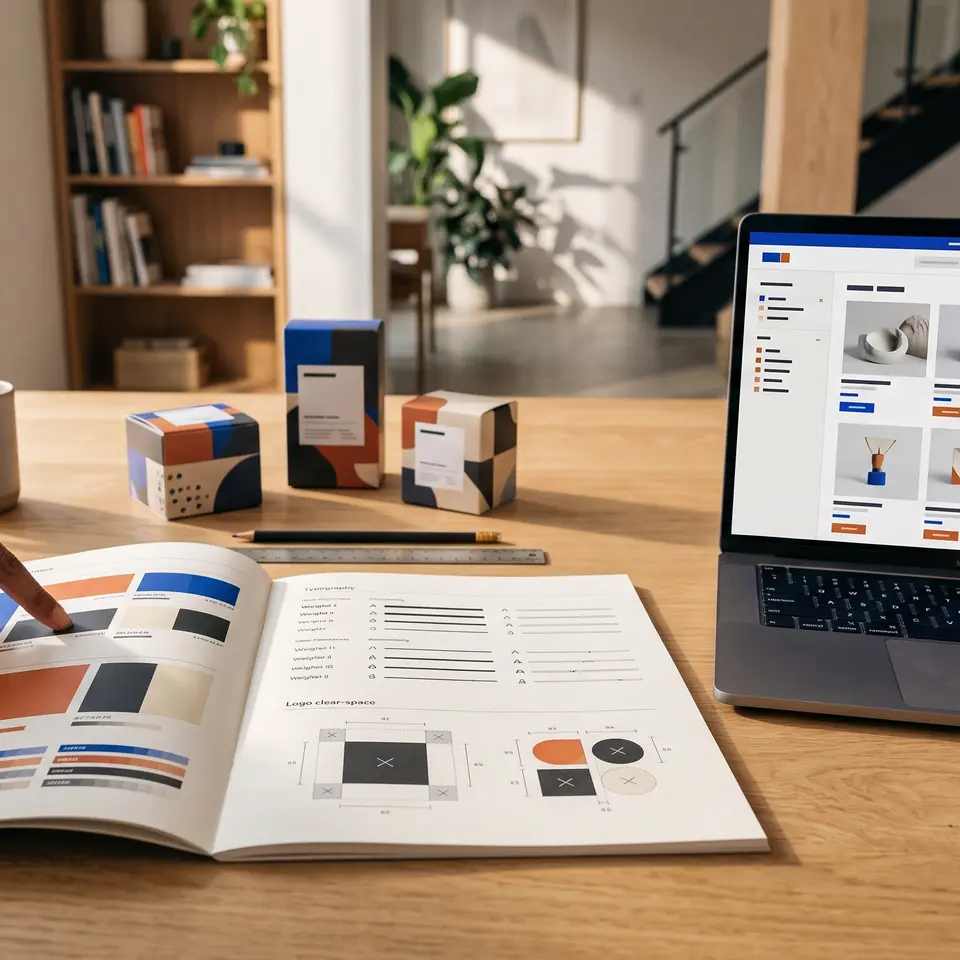
Brand guidelines examples show how visual rules, voice, product evidence, and approval boundaries work together in real customer-facing situations. For an ecommerce team, the useful example is not a beautiful PDF alone. It explains how the brand should behave on a product page, collection, campaign destination, and small screen. Runner AI can turn the rules and store context you supply into a focused storefront proposal that remains open to review.

What useful brand guidelines examples show
Strong examples make a rule concrete enough for another person to apply without guessing. A color section should do more than display swatches: it should identify approved values, accessible combinations, background limits, and situations where an accent color should not become the primary action. A logo section should define approved files, minimum size, clear space, background treatment, and prohibited changes. Typography guidance should connect families and weights to headings, body copy, prices, labels, and dense product specifications rather than stopping at a specimen page.
Verbal guidance needs the same precision. “Friendly” or “premium” is difficult to review until the guide shows how that voice changes a product benefit, validation error, shipping explanation, promotion, and return condition. Good examples separate enduring voice from situational tone. They also distinguish approved product facts from brand expression. A writer can make verified information clearer, but the brand guide should never authorize an invented material, unsupported benefit, false scarcity message, or delivery promise.
For ecommerce, application examples matter because the storefront contains changing data and interactive states. The same brand system must survive long product names, unavailable variants, sale prices, missing media, form errors, translated copy, and mobile navigation. Inspiration galleries often emphasize polished campaign assets. Store teams need examples that expose these ordinary constraints and show who verifies the result before publication.
Four brand guidelines examples for ecommerce teams
1. A visual foundation with usable limits
Imagine a home-goods brand that defines a warm neutral palette, one dark text color, one action color, two type families, and a quiet photography style. A useful guide shows those choices on a homepage, collection card, product detail, cart notice, and email destination. It also demonstrates contrast-safe text, focus states, image crops, long headings, and a sold-out product. The example succeeds because it translates aesthetic intent into decisions a designer and developer can inspect. It does not assume every page should use every brand element at once.
2. Product voice with evidence boundaries
Consider a technical accessories store whose voice is direct, specific, and calm. Its guidelines can pair an approved product record with on-brand and off-brand descriptions. The approved version explains compatibility, dimensions, included parts, and care in the order a buyer needs them. The rejected version adds an unverified performance superlative or hides an important limitation. This example teaches more than tone: it shows how voice operates inside factual boundaries. The AI ecommerce product descriptions workflow is an adjacent way to connect catalog evidence and reviewable copy decisions.
3. A campaign rule that preserves the store promise
A seasonal campaign can adapt the visual emphasis and tone without changing the underlying offer. A practical guideline example places a social concept, landing-page opening, collection introduction, and product page side by side. Each format has a different amount of space, but the eligible products, dates, exclusions, price, and next action remain consistent. The example should also show what happens when a featured variant becomes unavailable. This prevents “consistent branding” from becoming identical copy everywhere while protecting the facts that customers rely on. See how an integrated marketing strategy keeps channel and storefront handoffs aligned.
4. Localization and accessibility as brand behavior
A multilingual store needs more than translated slogans. Its guidelines should identify product names that remain unchanged, approved local terminology, unit conventions, tone differences, text expansion, right-to-left considerations when relevant, and the reviewer responsible for each market. The visual example should still work at text zoom, with keyboard focus, and when a translated button becomes longer. Accessibility is not a competing style layered on after branding; it is evidence that the brand can communicate under real conditions. Locale-native review remains necessary because a generated draft cannot verify cultural meaning or legal suitability by itself.
Turn supplied rules into reviewable Runner AI storefront work
Start with the source material your team actually approves: logo files, color values, typography, image direction, voice and terminology, product records, audience, page goal, examples of allowed and disallowed use, accessibility requirements, and any claims or policies that need specialist review. Identify which rules are firm, which allow variation, and which questions remain unresolved. This produces a better brief than asking an AI system to “make the store feel premium” without defining what that means.
Runner AI can use the context you provide when creating or revising storefront files. Request one bounded application, such as a homepage opening, collection route, product-page section, or campaign destination. Name the products and customer decision involved. Ask the proposal to preserve current navigation, use only approved assets and facts, expose uncertain inputs, and include the responsive states that matter. The output can then be inspected in the changed files and working preview rather than accepted as an unexplained image.
Review the proposal against the guide and the live product record. Check hierarchy, typography, color, imagery, voice, prices, variants, availability, policy language, links, focus visibility, text scaling, and mobile behavior. If one area misses the rule, request the smallest useful revision instead of replacing correct work. The ecommerce content marketing workflow shows how approved catalog and brand context can stay connected to storefront content. Browse all Runner AI features when the issue belongs to another website, conversion, or commerce workflow.
Review brand rules against real store states
A brand system is incomplete when it works only in a presentation. Test it against representative customer paths: arriving from a campaign, scanning a collection, comparing products, selecting a variant, reading a policy, encountering an error, and moving toward checkout. Include an unusually long product name, a low-stock or unavailable item, a discounted price, missing optional media, a translated route, and a narrow viewport. These states reveal whether the guidance creates clarity or merely protects a visual ideal.
Keep operational ownership explicit. Runner AI can prepare reviewable storefront work from supplied context, but catalog, inventory, pricing, consent, payment, fulfillment, analytics, and legal systems remain authoritative for their own facts and controls. A preview does not prove that checkout is configured, an asset is licensed, a color combination is accessible, or a claim is approved. People responsible for those decisions should verify the proposal before publication and test the public customer path after release.
Treat each review as input to the guide. If teams repeatedly misapply a logo on product media, struggle with promotion exclusions, or cannot fit translated labels into a component, add a concrete example and owner to the source guidelines. That turns brand governance into a maintained operating resource instead of a static document. It also gives the next storefront request clearer constraints and makes approval faster without lowering the standard of evidence.
Brand guidelines examples FAQ
What are brand guidelines examples?
Brand guidelines examples demonstrate how a brand’s visual identity, voice, messaging, assets, and usage rules apply in specific situations. Useful ecommerce examples cover storefront pages, product information, campaigns, responsive layouts, localization, accessibility, and failure states. They include both approved and prohibited applications so designers, writers, developers, partners, and reviewers can make consistent decisions without inventing missing rules.
What should ecommerce brand guidelines include?
Include brand purpose, audience, logo rules, colors, typography, imagery, iconography, voice, terminology, approved claims, accessibility requirements, localization guidance, asset locations, ownership, and an update process. Add examples for homepage, collection, product, campaign, cart-adjacent, error, mobile, and translated states. Keep authoritative product, price, stock, policy, and operational facts in the systems that own them.
How can Runner AI use brand guidelines?
Provide Runner AI with the approved guidelines, store context, relevant product records, page goal, assets, constraints, and review criteria. It can use that context to prepare or revise bounded storefront work, such as a section or page, while keeping the implementation and preview available for inspection. A person still verifies every fact, rule application, responsive state, connected service, and publication decision.
Do brand guidelines replace a design system?
No. Brand guidelines explain how the organization should look, sound, and behave across contexts. A design system translates part of that direction into reusable components, tokens, interaction patterns, and implementation guidance. Ecommerce teams often need both: the brand guide supplies intent and usage boundaries, while the design system helps the storefront apply those decisions consistently in code.